Losing Hand

When gaming money goes to businesses, it’s not helping nonprofits or municipalities
For example, over 120 government applications in Dauphin County went unfunded as for-profit businesses collected gaming revenue meant to benefit communities.
As businesses cashed out on Dauphin County’s gaming grant program, nonprofits and municipalities often didn’t get the amount of funding they requested.
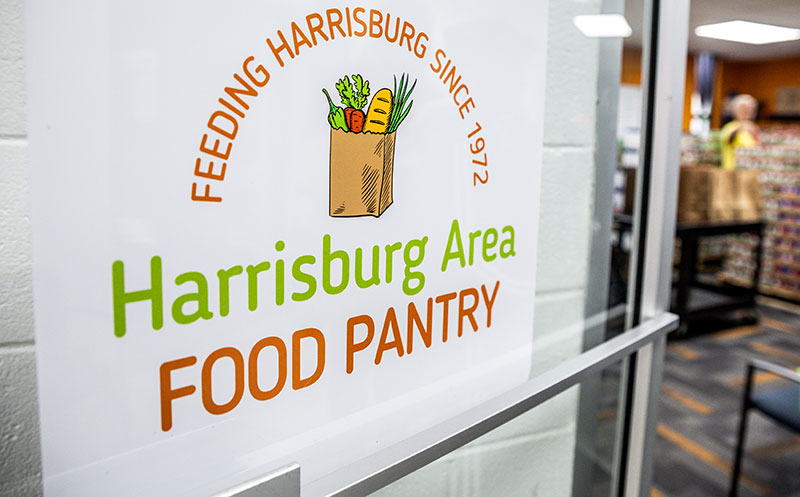
In 2024, the same year the county commissioners awarded $18,750 to renovate space for a new Playa Bowls store, they awarded the Harrisburg Area Food Pantry $15,000 of a $75,000 request for emergency food assistance.
And the year before, a for-profit drone company got $22,000 to buy equipment to expand its business offerings, while these requests got nothing: playground upgrades for Lower Paxton Township Parks & Recreation and projects to improve early childhood reading, including giving books to schools, from Capital Region Literacy Council.
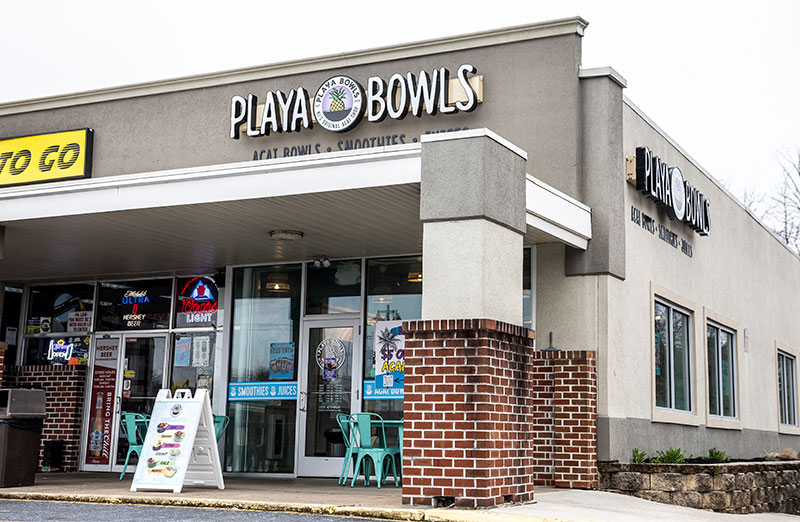
Playa Bowls at the Park Village Plaza in Derry Township. April 2, 2026. Dan Gleiter
Even public safety and infrastructure improvements — which are among the types of projects the gaming grants are meant to prioritize — have at times not received their full requests. A few examples from 2024:
- West Hanover Township got about half of its $426,000 request for new radios for its fire company.
- The Dauphin County sheriff’s office got less than half of its $140,000 request for radio and vehicle replacement.
- Middle Paxton Township got $52,000 of a $150,000 request for bridge maintenance.
In response to questions about why some projects did not receive funding, a county spokesperson noted the competitiveness of the program.
“When the demand for grant funding exceeds the availability of funds, hard decisions have to be made about which applications to approve and which to reject, and reasonable people can disagree on the worthiness of any individual application,” the spokesperson wrote in an email.
Some local governments feel they’re not getting their fair share of the money. Lebanon County, which Hollywood Casino borders, gets $220,000 annually, compared with Dauphin County’s millions.

And some say municipalities close to the casino, like its host township, East Hanover, also deserve a bigger slice of the pie.
In 2008, East Hanover Township and Dauphin County had an agreement that gave the township priority consideration for up to $3 million annually in gaming grants. That agreement expired in 2011.
Because it hosts the casino, the township gets a chunk of change directly from the facility — about $1.3 million annually over the past three years. But since the township’s agreement with Dauphin County expired, the amount it has gotten from county gaming grants has steeply declined, from over $3 million per year to between $500,000 and $750,000 per year in recent years.
“It’s clear to me the way it’s written, somebody had to intentionally create a scenario that was to the advantage of the county and the disadvantage of the municipality,” Eric Epstein, a government watchdog and consultant hired to work on the agreement, said of the state gaming law.
The projects that received no funding include:
- A $174,000 request from Middle Paxton Township for a fire company addition;
- A $150,000 request for playground renovations from Lower Paxton Township in 2023;
- A $150,000 request from multiple Harrisburg departments to replace the HVAC system in the public safety building;
- A $115,000 request for pedestrian safety improvements in Lykens Borough in 2018;
- Numerous requests for debt reduction for fire stations.
Dauphin County’s municipalities range in size considerably. The smallest, Rush Township, has about 300 residents, while the largest, Lower Paxton Township, has more than 56,000.
The casino sits in East Hanover Township, on the eastern border of the county, and much of its impact is concentrated in nearby municipalities. They assist with fire calls to the casino, fix roads for casino-goers and deal with traffic for events.
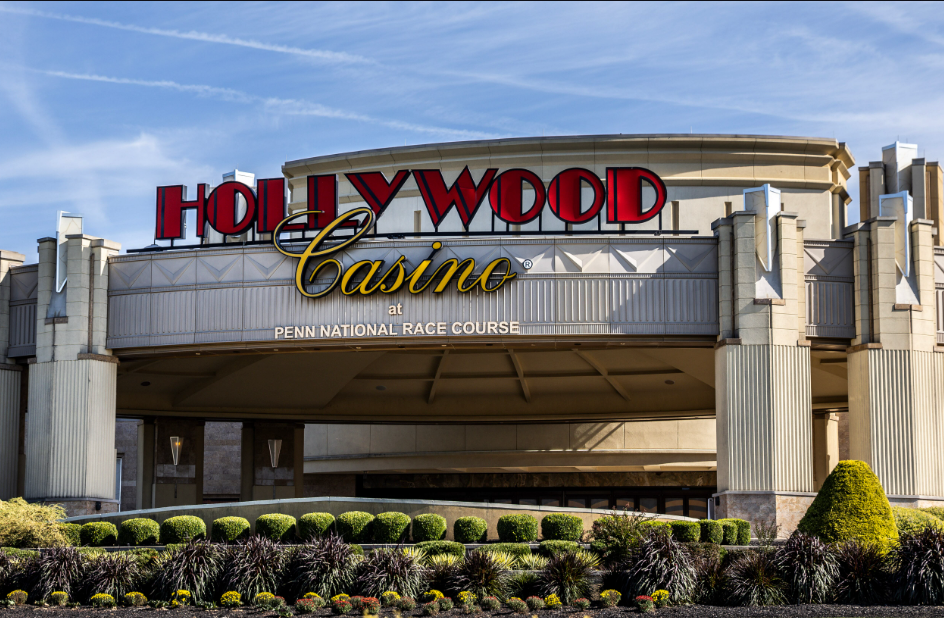
Hollywood Casino at Penn National Race Course. October 2, 2025. Dan Gleiter
That includes West Hanover Township, which sometimes assists with fire calls at the casino.
There’s only so much smaller municipalities can do to raise money, West Hanover Township Finance Director Timothy Houck said.
“You can only raise taxes so much, and you have to do what’s right for the residents,” Houck said.
When the township requested $426,000 to buy radios for its fire company in 2024, it got about half of its request and took money out of its general fund to pay for the rest. That same year, the township took out bonds for a new municipal building. When it requested a gaming grant for reimbursement for the first two interest payments in 2025, it got about two-thirds of its $370,000 request.
This year, the township is asking for the same thing.
“Whatever we get we’re thankful for,” Houck said, “but hopefully they do the right thing going forward.”
When municipalities don’t get the money they ask for, they often have to pivot from their original intentions.
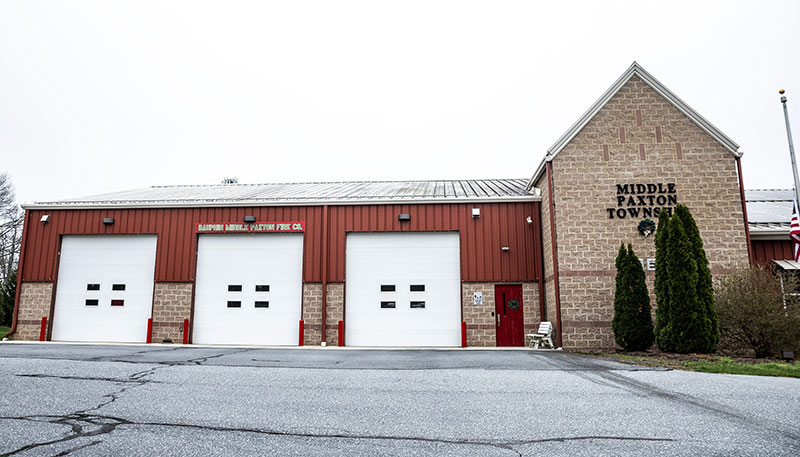
Since Middle Paxton Township didn’t get the $174,000 it requested in 2024 to add a bay for fire trucks at the township building, the township is now discussing how they can adapt the existing structure to try to maximize space, Township Manager Julie Ann Seeds said.
Middle Paxton Township is one of the few municipalities in the state that doesn’t have property taxes. Instead, it relies on income taxes. With rising construction costs, grants are helpful when the township tries to pay for infrastructure projects, Seeds said.
“It helps to be able to apply for grant opportunities rather than have to take out loans for 20, 30 years or more,” she said.
When asked about competing against for-profits, Seeds said it’s up to the gaming advisory board to review the grants and dole out funding “for the needs of the people.”
How Hollywood Casino’s revenue is divvied up was called into question before the 2004 Gaming Act was signed into law.
At a 2004 hearing for the bill, former state Rep. Ron Marsico (R-Dauphin) said East Hanover Township’s cut of the funds was “nothing but a drop in the bucket” compared to the money it would have to spend on casino-related infrastructure and other expenses.
“To further rub salt in the wound, Dauphin County would get 1% of revenues for itself, even though it will bear virtually none of the slots-related costs, and another 1% that it can give in the form of grants to virtually any municipality in the county,” Marsico said at the hearing. “I do not understand it. Tell me, where is the logic?”
Swatara Township, one of the largest municipalities in the county, has gotten more than $150,000 of the county’s gaming revenue each year since 2020. Swatara Township Commissioner Tom Connolly said the township applies for projects that benefit the public, and it’s up to county commissioners to decide what percent of its requests are funded.
Connolly believes population should be the deciding factor and that municipalities should be the ones who dole out grants, not the county.
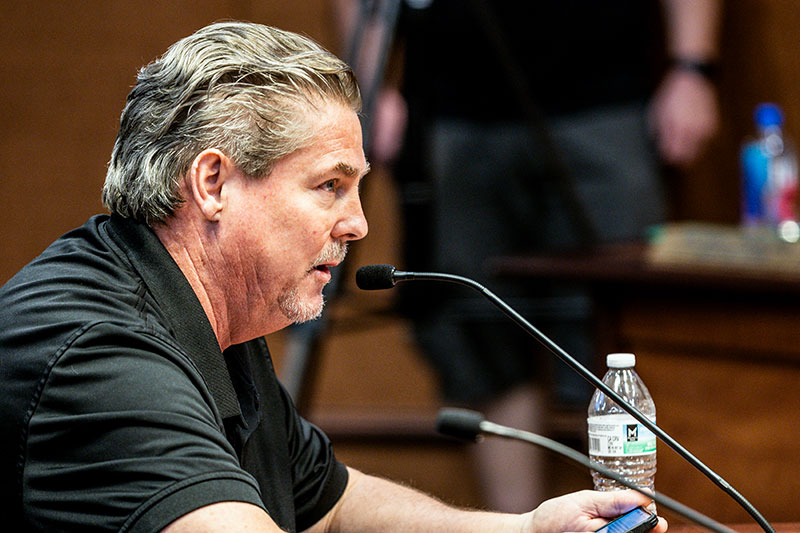
Swatara Township Commissioner Tom Connolly speaks at the Dauphin County Commissioners meeting. April 30, 2025. Dan Gleiter
“The gaming money should only be a pass-through for Dauphin County. It should go to the municipalities based on the percentage of their population,” Connolly said. “Let us decide what would have the most impact in our community, whether it’s a nonprofit, a new police car, a park or any number of things that would benefit the public.”
The casino sits on the border of Lebanon County, which has been trying for years to secure a bigger piece of the gaming revenue.
State Rep. Russ Diamond (R-Lebanon) has been leading that charge.
“The local share amounts were all pretty much political decisions. Those who voted in favor of the original slots bill, their areas were treated favorably for local share, and those who voted against it, they got locked out,” Diamond said.
According to him, Dauphin County and Lebanon County are perfect examples.
“Dauphin County has benefited greatly from it, sometimes to the tune of about $15 million a year, while Lebanon County has received virtually nothing,” he said.
Dauphin County Commissioner Mike Pries said he is open to potentially working with Lebanon County officials to revisit their share of the gaming dollars.
“Maybe that’s something to look at down the road, because I’m going to assume that the fire companies from Lebanon County are going to be pretty close nearby if something happened out there,” he said.

For nonprofit organizations that rely on grant funding and fundraising to operate, the gaming grants can be particularly beneficial — but some nonprofit leaders feel they’ve been short-changed.
Of the nearly 1,100 gaming grant requests from nonprofits, about 12% have been fully funded.
It’s standard for governments to give grants to nonprofits, said Amanda Kass, research director for the nonprofit Good Jobs First, which promotes corporate and government accountability in economic development.
“For better or worse, nonprofits have come to do a lot of services and functions that municipal governments might have done at one point in time, but we’ve kind of outsourced those services and functions,” Kass said.
Nonprofits have needs and expenses that are increasing faster than their revenue and can’t only rely on fundraising, according to Anne Gingerich, executive director of the Pennsylvania Association of Nonprofit Organizations.
When nonprofits request grant money, they’re often asking for funds for programs or projects, not operational expenses, Gingerich said. When they don’t get the money, the projects often don’t happen. Some projects are so well received by the community that nonprofits can raise the funds, but others simply fade away, she said.
Among the nonprofits that didn’t receive their full funding gaming grant funding requests are:
- The Boys and Girls Club of Harrisburg, which requested $75,000 for safety and security upgrades in 2025 and received $20,000.
- The LGBT Community Center Coalition of Central PA, which in 2024 requested $75,000 for renovations to its new permanent location and received half of that amount.
- Downtown Daily Bread, which requested $50,000 in 2023 for emergency shelter, meals and services for people who are unhoused or are at-risk of becoming homeless and received $5,800.
Multiple nonprofit leaders expressed frustration with the way the gaming grant funds are allocated.
Camp Curtin Memorial-Mitchell Methodist Church, one of the few churches on the National Register of Historic Places, is on the former site of Camp Curtin and is a memorial to all Civil War soldiers.
It’s also crumbling.
More than a decade ago, a contractor specialized in old historic churches came to fix the roof and noticed a problem with the bell tower.
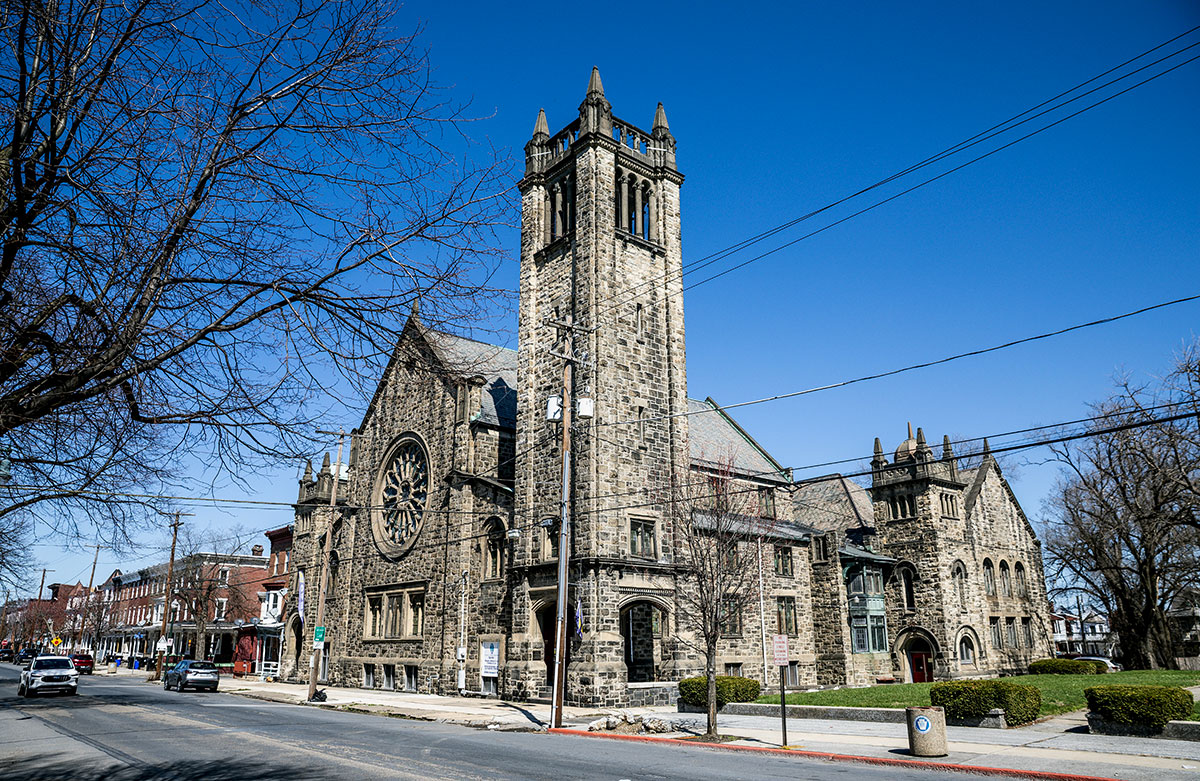
Two other engineers told the congregation the bell tower needed at least to be stabilized and, at worst, to be torn down and rebuilt. They told the church that if the bell tower fell, “it would be like a nuclear bomb went off on Sixth Street,” said Rhonda Mays, who was a member of the congregation at the time.
The congregation applied for gaming money twice, in 2015 and 2017. It was unsuccessful both times. During both of those years, commissioners funded the for-profit redevelopment of a luxury apartment complex.
The congregation eventually moved out of the church, and it was sold. The bell tower has still not been stabilized.
“I see it when I’m coming out of work every day, and I do think about it quite often,” Mays said. “I’m still quite concerned about it.”
As the commissioners debate this year’s awards, some nonprofits are fighting for funding.
NutriPacks, a food distribution program that serves over 1,600 students in the Central Dauphin School District, applied for $75,000 this grant cycle, but the gaming advisory board did not recommend funding it.
During a public meeting on April 8, when the commissioners were set to vote on the grants, NutriPacks Director Sandra Brooks pleaded with them to reconsider.
In the past, NutriPacks received seven gaming grants, including $75,000 in 2025. That represented 31% of its total food purchasing budget that year, Brooks said, noting that the community need has only grown since then.
“Without your financial award, our program will struggle to continue to serve in our current capacity,” Brooks said. “Families in our school district will be impacted. Students will not be able to focus in the classroom, impacting every facet of their lives.”
The commissioners declined to approve any grants during that meeting, with two of the three commissioners sharply criticizing the recommended grants list and the program at large. The proposed grants will likely come up for a vote again on Wednesday, April 15.
Commissioner Justin Douglas said he plans to abstain from voting on any gaming grants until the program is reformed, citing concerns raised by questions PennLive sent the commissioners for this investigation.
“Until substantive reforms are implemented, I cannot in good conscience continue to support this program in its current form,” Douglas said.
This story was fact-checked by Christine Vendel.
What did we miss? Reach reporter DaniRae Renno at drenno@pennlive.com and reporter Juliette Rihl at jrihl@pennlive.com or by encrypted email at jrihl@proton.me. Anonymous tips are welcome.
This reporting was supported by the Fund for Investigative Journalism and the Pennsylvania NewsMedia Association Foundation.